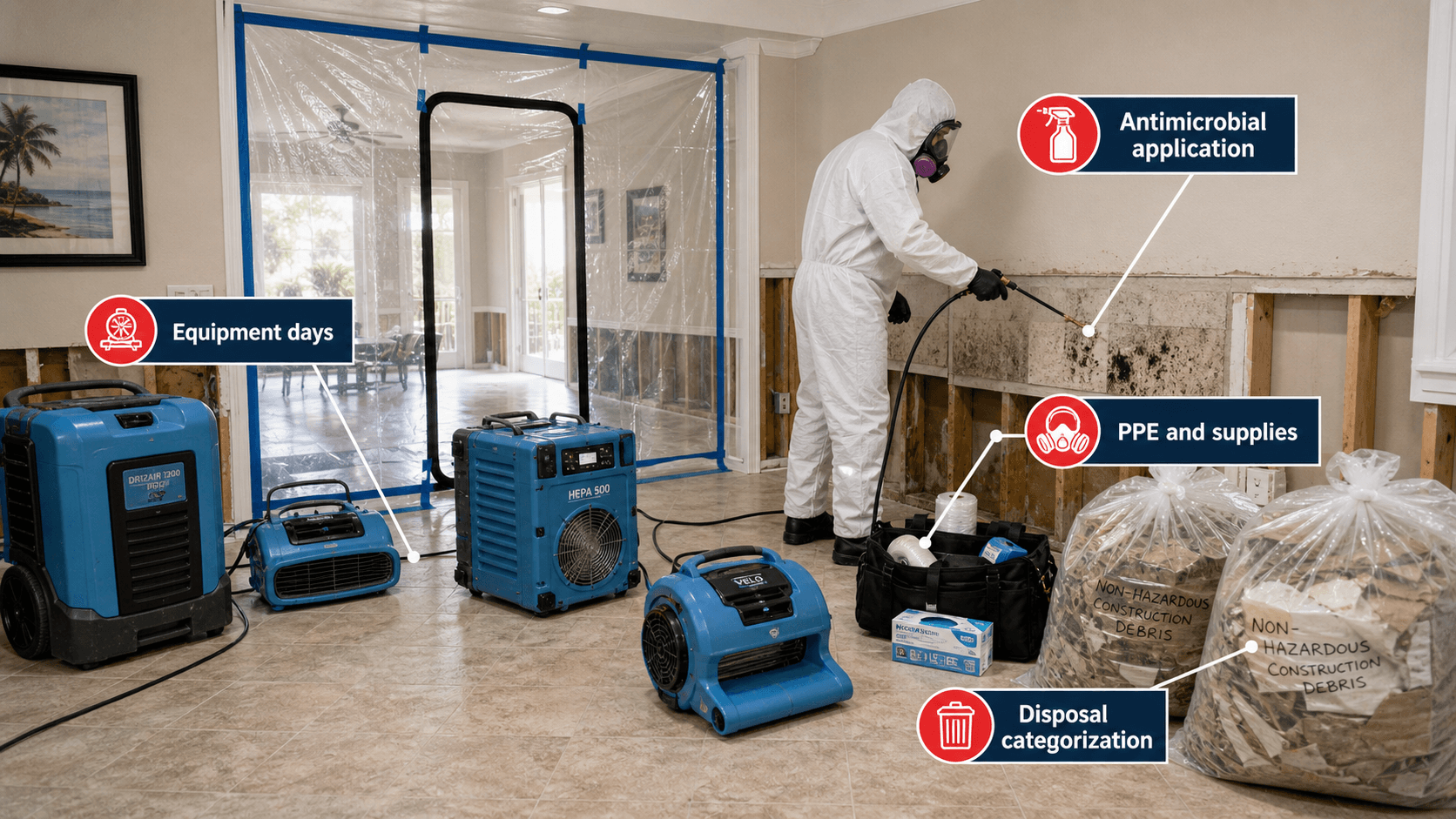
A restoration company runs a six-day dry-out on a Cat 2 water loss. Crews execute the work to standard. Equipment runs around the clock. Daily readings get logged. Photographs are taken at every stage. The invoice goes to the carrier in the company's standard format. Two weeks later, the Statement of Loss comes back with equipment days cut from six to four, antimicrobial application cut to a fraction of what was billed, PPE and supplies removed entirely, and disposal categorized down to a Cat 1 rate that doesn't reflect what was actually handled.
The work was real. The reductions are also real. The gap between them is documentation.
After 20,000-plus estimates and a meaningful share of those involving mitigation invoice rebuilds, the cuts that show up on Florida desk-adjuster reviews of dry-out invoices follow consistent patterns. Four line items account for the majority of the dollar value cut. Each one fails on the same root cause: the documentation does not anticipate the cut before it happens.
The four line items the desk adjuster cuts first
The pattern is not random. The desk adjuster's review tools and review playbook target the same four categories on nearly every mitigation invoice that comes through:
Equipment days. The single highest-value cut on most dry-out invoices. The desk adjuster's standard cut: "no documentation of necessity for the days claimed."
Antimicrobial application. Cut to "general cleaning" rate or removed entirely. Standard reasoning: the invoice doesn't establish that an antimicrobial protocol was warranted versus standard cleaning, or that the application was performed to a recognized framework.
PPE and supplies. Cut as "general overhead." Standard reasoning: items are not separately documented with use rationale, so they are absorbed into general project costs the carrier considers already covered.
Disposal categorization. Cut to Cat 1 disposal rate regardless of what category of water the work involved. Standard reasoning: the invoice doesn't distinguish what was disposed of, in what quantity, under what category, and to what facility.
These four cuts are not opinions. They are operational defaults that desk adjusters apply when the invoice doesn't preempt them. The fix on each is specific.
Equipment days: psychrometric documentation per ANSI/IICRC S500-2021
Equipment days get cut because the carrier's reviewer cannot see, from the documentation alone, that the days claimed were necessary. The equipment was running. That is not in dispute. The dispute is over necessity — over whether the equipment needed to run for the days billed, given the conditions in the structure.
The framework that establishes necessity is psychrometric documentation: daily readings of temperature, relative humidity, grain depression, and dehumidifier performance, taken from each affected area, recorded against drying targets, and tracked over the duration of the dry-out. This is operational documentation that aligns with the methodology described in ANSI/IICRC S500-2021. The standard itself describes the framework. Your documentation operationalizes it.
In practice, an invoice that cites ANSI/IICRC S500-2021 by reference and includes daily psychrometric logs as supporting documentation gets a different review than an invoice that doesn't. The desk adjuster cannot easily cut equipment days when the documentation establishes that drying targets governed equipment placement and removal decisions on each day.
The operational implication is straightforward. Daily readings are not a paperwork tax. They are the evidence base that protects every equipment day on the invoice.
Antimicrobial application: protocol citation per ANSI/IICRC S520
Antimicrobial line items get cut because the desk adjuster reads them as cleaning costs that should be absorbed elsewhere. The cut is defensible when the invoice doesn't establish three things: that an antimicrobial protocol was warranted, what protocol was applied, and how the application was performed.
ANSI/IICRC S520 provides the framework for distinguishing situations where antimicrobial application is appropriate versus situations where standard cleaning is sufficient. In Florida, the differentiation matters because the cost difference between the two is substantial and the carrier's default treatment is the cheaper one unless documentation establishes otherwise.
The fix in documentation involves three elements: a clear note of why an antimicrobial protocol was warranted on this particular loss (typically tied to water category, contamination indicators, or affected materials), citation of the framework reference (ANSI/IICRC S520) under which the protocol was applied, and area-by-area documentation of where the antimicrobial was applied with square footage treated. None of this requires reproducing the standard's text. All of it requires the operational record of what was done and why.
When an invoice carries that documentation, the antimicrobial line shifts from "general cleaning" treatment to a recognized protocol-based line item the desk adjuster cannot easily reduce.
PPE and supplies: itemization that survives "general overhead" rejection
PPE, antimicrobial supplies, containment materials, and consumables get rolled into "general overhead" by carrier reviewers when the invoice presents them as bundled or unspecified line items. The reviewer's logic is that the carrier already pays for general overhead implicitly, so separately billed PPE is double-charging. The cut is automatic.
The reframe that prevents this is itemization at the SKU and use level. Each category of PPE — respirators, suits, gloves, eye protection — separately listed, with quantity used, dates of use, and number of personnel. Each category of consumable supplies — antimicrobial product, containment plastic, tape, bags — separately listed with quantity, application location, and use rationale.
When the invoice presents PPE and supplies as itemized job-specific costs with use rationale, the "general overhead" categorization fails. The line items survive review because each one is a specific cost tied to a specific aspect of the work.
This is operational documentation that takes a small amount of additional time during the job and prevents the cut entirely on review. The discipline of capturing it daily, by technician, is what separates restoration companies that get paid in full from restoration companies that absorb 25% to 45% reductions on every invoice.
Disposal: categorization by water category and weight/volume manifest
The disposal cut is often the simplest in dollar terms but the most consistently misapplied. The desk adjuster's default is to pay disposal at the Cat 1 rate — ordinary construction debris — regardless of what was actually disposed of. The reasoning is again documentation-driven: if the invoice doesn't distinguish the category of waste, the carrier doesn't pay the higher categorical rate.
The fix involves classification of waste at the time of disposal, weight or volume documentation per disposal load, and a manifest that ties disposal events to facilities. ANSI/IICRC S500-2021 informs the categorization framework. The actual documentation lives in disposal manifests from the facility, dated load tickets, and photographic evidence of containment and transport.
When disposal is documented at this level, the desk adjuster cannot cut the line item to a lower categorical rate without contradicting the invoice's documented basis. The substitution argument that defaults to Cat 1 disposal does not survive a manifest that establishes what was disposed of and where.
What changes when the invoice gets rebuilt
Restoration companies that have had invoices rebuilt by a third party generally see one of two patterns on the revised submission. Either the invoice clears review at substantially full value, or the invoice triggers a different category of carrier response — typically a request for a re-inspection or a supplement negotiation rather than an automatic cut.
Both are wins. The first wins on dollar value and DSO. The second moves the file from automated cut to active negotiation, which usually closes at a recovery substantially higher than the automated cut would have produced.
The structural reason rebuilt invoices perform differently is not aggressive pricing. It is documentation that anticipates the four cut categories before they occur. Each line carries the framework reference, the operational documentation, and the categorical specificity that closes the room for the cut.
The free invoice rebuild
WorldClass Estimates offers a no-cost rebuild of one open invoice per company. The work involves analyzing the existing invoice, identifying where the four cut categories are exposed, and rewriting the document in carrier-format Xactimate with the documentation each line item needs to survive review.
The rebuild is not aggressive. It does not inflate the invoice. It restores defensibility to documentation that may already cover the work performed but doesn't communicate that defensibility to the carrier's reviewer.
If the rebuild produces an invoice that performs better on resubmission, there's a conversation about how WCE handles ongoing invoices for your firm — water, fire, mold, and wind, with Xactimate documentation that aligns with current ANSI/IICRC frameworks and Florida's Rule 69BER24-4 by default. If the rebuild doesn't produce a measurable improvement on resubmission, you've still received a technical second opinion on a stuck invoice at no cost.
The offer is one rebuild per company. Send the invoice that has been waiting longest for full payment.