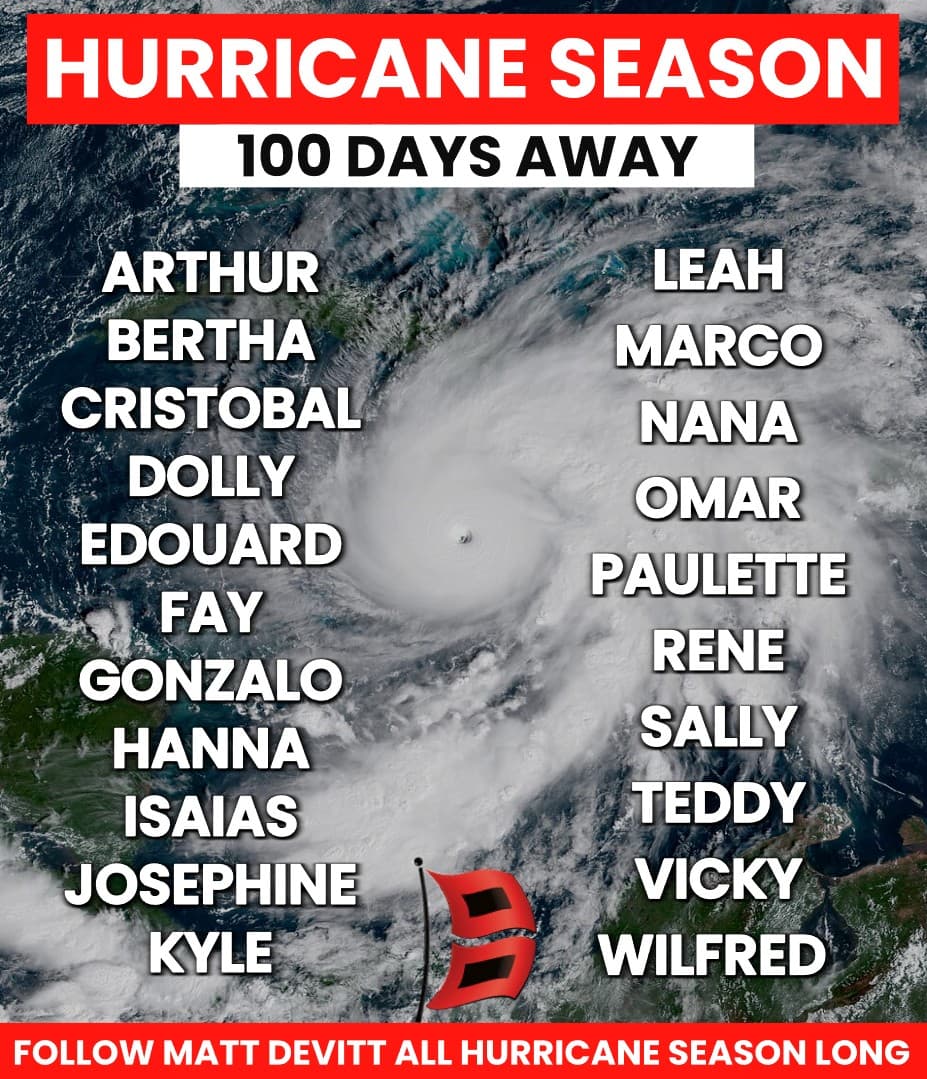
The 2026 Atlantic Hurricane Season opens on June 1 and runs through November 30. The National Hurricane Center begins regular Tropical Weather Outlooks on May 15 — about two weeks before the official start. As of early May, every operational decision a public adjusting firm or restoration company makes about the next six months is downstream of one question: how much capacity have you already locked in for surge demand, and how much are you betting you'll be able to find when claims start hitting?
The forecasts are interesting this year. The operational implications are more interesting.
The 2026 forecast at a glance
Three credible forecasters published April outlooks. The numbers are tighter than usual.
Colorado State University's April 9 forecast called for 13 named storms, 6 hurricanes, and 2 major hurricanes — slightly below the long-term average. CSU cited a likely transition to El Niño conditions during the peak of the season as the dominant suppressing factor. Their Accumulated Cyclone Energy projection came in at 90 units, roughly 75% of the long-term average.
AccuWeather's range ran higher: 11 to 16 named storms, 4 to 7 hurricanes, 2 to 4 major hurricanes. Critically, AccuWeather projected 3 to 5 direct U.S. impacts during the season — a number that has not changed materially from recent years even when total storm counts were higher.
Tropical Storm Risk forecast 12 named storms, 5 hurricanes, 1 major hurricane.
The University of Arizona was an outlier on the active side, projecting 20 named storms, 9 hurricanes, and 4 major hurricanes — comparing 2026 conditions to 2023, when warm sea surface temperatures overwhelmed an emerging El Niño and produced a busier-than-expected season.
The common thread across forecasts: El Niño is the variable. If it develops on the timeline currently expected, the second half of the season will be quieter than the first. If it develops late or weakly, the back half could match or exceed average.
For property claims work, the storm-count number is the wrong number to look at. The number that matters is U.S. landfalls and direct impacts. AccuWeather's 3-to-5 figure is the operational planning number for Florida.
Three operational shifts since the 2025 season
The 2025 season closed with 13 named storms, 5 hurricanes, and 4 major hurricanes — including three Category 5s (Erin, Humberto, and Melissa). Most of the activity occurred after September 10, the climatological peak. That late-loaded distribution caught a significant share of the Florida market unprepared. Several patterns from 2025 carry directly into how 2026 should be planned:
The carrier review window has compressed. Through late 2025, multiple Florida carriers tightened their internal SLA on first-pass review of claim documentation. What used to be a 30-day desk review is now landing closer to 15 days for first response. That sounds like good news. It is not. The compressed window means the documentation submitted has to be defensible on first read — there is much less room for the back-and-forth that used to absorb early-cycle ambiguity.
Mass-review automation expanded at the desk-adjuster level. Several large carriers expanded automated first-pass review of mitigation invoices and Xactimate estimates submitted in standard format. Submissions that fall outside the carrier's expected format — Excel sheets, proprietary contractor templates, hand-built scope sheets — now route to a slower manual review queue. Submissions in standard Xactimate ESX format with proper IICRC documentation route to the fast queue. Same claim. Different submission format. Different treatment.
Statute §627.70152 deadlines are being enforced more strictly. Florida's pre-suit notice and proof-of-loss requirements were already binding. In 2025, several Florida courts dismissed or restricted claims where the policyholder's documentation arrived late or incomplete. The downstream effect for PA firms and restoration companies: a late or disorganized estimate now has consequences that go beyond the carrier's negotiation posture. It can affect the case itself.
These shifts compound during a hurricane season. They are not theoretical. They are how every claim in Q3 and Q4 is going to be reviewed.
Why estimating capacity in Florida is a finite resource
Most firms talk about hurricane preparation as if it's a checklist of supplies and templates. The actual constraint is not paper. The actual constraint is hours of qualified estimating work available between June and November.
Florida has a finite number of estimators with the combination of experience, certification, and bilingual capability that the post-2025 market requires. That number does not expand during hurricane season. It contracts, because the same estimators are spread across more files. By the second week of a major event, every quality estimating firm in the state is operating at capacity. By the third week, they are turning away work or pushing turnaround times to figures that miss carrier review windows.
The math from the 2024 and 2025 seasons is consistent: estimating turnaround time on third-party-written estimates roughly doubled within 14 days of any major Florida landfall. Firms that had pre-arranged overflow capacity kept their turnaround steady. Firms that tried to find capacity after the storm hit either paid premium rates for whatever was left or accepted turnarounds that exposed their cases to compressed review windows.
This is not a marketing observation. It is an operational one. The decision to lock surge capacity is made in May. The cost of waiting until July is paid in August.
The math of waiting until July
Consider a Florida public adjusting firm carrying 60 active files at the start of June. Average claim disputed value: $80,000. Average PA fee: 10% of recovery. The firm's in-house estimator can sustainably write 8 to 10 quality estimates per week.
A Category 2 storm crosses South Florida in mid-July. The firm picks up 40 new files in the first 10 days. The in-house estimator is now sitting on 100 active files needing initial estimates, supplements, or revisions, with a sustainable throughput of 8 per week. Math is brutal: roughly 12 weeks to clear the queue at current pace, against carrier review windows that close in 15 days.
Two paths:
Path one — the firm calls around looking for overflow estimating help in late July. By that point, every quality firm in Florida is already at capacity. Available work is from firms that had spare capacity precisely because they had nothing to do, which is its own signal. Turnaround on emergency outsourced work runs 10 to 14 days at premium rates. Quality is variable. Several supplements are submitted late and reduced.
Path two — the firm pre-arranged a surge-capacity agreement in May with one quality partner. New files route to the partner within 24 hours of intake. Turnaround stays at 5 to 7 days. Carrier review windows are met. Supplements are submitted on time and at full strength.
The cost difference between path one and path two on a 40-file post-storm intake, at a 10% PA fee, is not a marketing number. It is real money. Multiple PA firms in Florida built their 2024 and 2025 results on the difference between those two paths.
The same arithmetic applies to restoration companies measuring DSO instead of fee recovery, and to attorney firms measuring case throughput instead of either.
Pre-season checklist: four things to lock before May 30
The four operational moves that separate firms that perform during hurricane season from firms that survive it. Each takes less than a week to execute.
One — Lock overflow estimating partners now. The agreement does not need to be a long contract. It needs to specify intake capacity (how many files per week your partner will accept from you), turnaround commitment, and pricing. Make it before May 30. By July, every quality firm worth working with will be saying yes to the firms that asked first and no to the firms that asked late.
Two — Standardize the scope intake form your team uses. When the volume hits, the firms that win are the firms whose intake forms produce consistent, complete information that an estimator can work from without follow-up calls. The most common failure mode in surge season is not bad estimating — it is good estimating starved of complete intake data. Define the photo grid, the scope sheet template, the IICRC documentation requirements, and the carrier-specific notes your team will collect on every file. Train every intake-side person on it.
Three — Pre-build your code citation library. Florida Building Code, International Residential Code, and local ordinance citations relevant to common Florida claim types should be at fingertip access. Researching code mid-claim during a surge is how mistakes get made. The 2023 FBC Residential 8th Edition has shifted several section numbers from the prior version. Confirm that any citation library your team maintains is current to the 8th Edition.
Four — Tier your incoming files by complexity from day one. Class 1 water and Class 4 water need different turnaround commitments. A small wind-loss supplement and a large commercial fire claim cannot share a queue. Decide your tiering rule before files start arriving. Apply it from the first day of every event.
These four moves are not glamorous. They are why some firms grow during hurricane seasons and others contract.
WCE's surge-capacity program
WorldClass Estimates is committing 30 surge-capacity slots for the 2026 hurricane season. Slots are first-come and locked through November. Public adjusting firms, restoration companies, and attorney offices that reserve before May 30 receive priority queueing on every file submitted during the season — even when the general queue is at capacity.
The program is designed for firms that already have an in-house estimator and need overflow capacity, not for firms looking to outsource their full estimating function. Standard turnaround commitments apply: remote estimates in 24 to 48 hours, on-site estimates in 5 to 10 business days, with priority lane handling for slot holders.
Reserved slots include access to WCE's Florida-specific compliance package by default — Audit Report and Variation Report aligned with Rule 69BER24-4, ANSI/IICRC framework references, and current FBC citations.
Hurricane season is going to happen on June 1. The firms that perform during it will be the firms that locked their decisions in May.
Sources cited: NOAA National Hurricane Center 2026 season page (nhc.noaa.gov); Colorado State University Tropical Weather & Climate Research April 9, 2026 forecast (tropical.colostate.edu); AccuWeather 2026 Atlantic Hurricane Season forecast (accuweather.com); FOX Weather coverage of El Niño outlook April 2026 (foxweather.com).