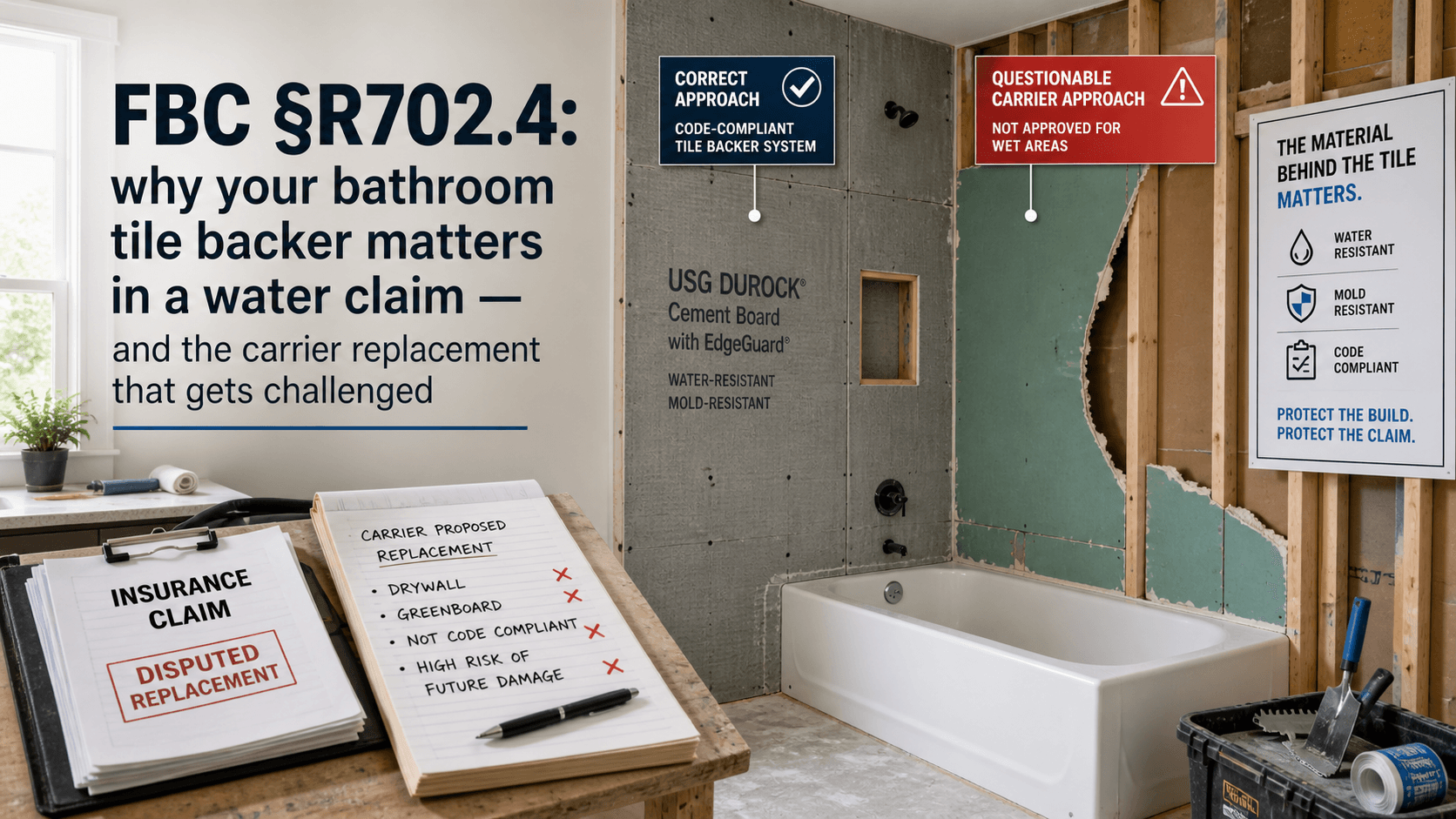
A water loss damages a bathroom tub-and-shower assembly. The tile is broken. The wall behind the tile is wet and likely compromised. The carrier's adjuster authorizes replacement of the tile and the drywall behind it. The work proceeds. The check clears.
Eighteen months later, the policyholder discovers mold behind the new tile. Investigation reveals that standard gypsum drywall was installed behind the tile rather than a proper tile backer. The wall failed in the same way as the original failure. The policyholder is now asking who pays for the second loss.
The answer involves a section of the Florida Building Code that is straightforward to cite, well-established in code-upgrade jurisprudence, and consistently undercoded in carrier-authorized scope. The pattern is common enough that public adjusters and property attorneys benefit from understanding the specific section, the exact requirement, and how to document the argument before the original repair scope is approved.
This article addresses the public-domain Florida regulatory text — the Building Code itself — which can be cited verbatim with proper reference. It does not address copyrighted standards, which require different handling.
The 8th Edition is the current code
Before getting to §R702.4, a foundational point about citation discipline. The Florida Building Code is updated on a three-year cycle. The current edition as of the publication of this article is the 8th Edition (2023), published by the Florida Building Commission and based on the 2021 International Residential Code with Florida-specific amendments. The 7th Edition (2020) is no longer the active code for purposes of new permits or current code-driven scope arguments.
This matters because section numbers shift between editions. A code citation from a 2020-vintage estimate or memo may reference a section number that has moved or no longer reads the same way. Any code-citation reference library used in property estimating work should be current to the 8th Edition. When a carrier challenges a code citation, the first thing reviewed is whether the section is correctly identified in the current edition.
For Florida loss work, code citations should be made by edition number, year, and section: "Florida Building Code Residential, 8th Edition (2023), §R702.4." That format gives the carrier's reviewer no procedural ground to dismiss the citation.
What §R702.4 covers
§R702.4 of the Florida Building Code Residential, 8th Edition (2023) addresses tile installations and the backers required behind them. The section sits within Chapter 7 — Wall Covering — and works in coordination with §R702.3.8, which addresses water-resistant gypsum backing board generally.
The substantive requirement of §R702.4 and its subsections is that wall tile installed in tub and shower areas requires a tile backer of specific composition — fiber-cement, fiber-mat reinforced cement, glass mat gypsum backers, or fiber-reinforced gypsum backers complying with the relevant ASTM standards. Standard gypsum drywall — even water-resistant gypsum (the product commonly called "green board") — has limitations on use as a tile backer in wet areas, addressed in §R702.3.8.1.
The practical effect of these sections together: where wall tile is installed in tub and shower areas, a tile backer of approved composition is required. Standard drywall, including water-resistant variants, is not an approved substrate for this application under the current code.
This is not a contested or novel reading. It is the plain text of the section as currently published. The Florida Building Commission publishes the code through Florida Building's official website (floridabuilding.org) and through licensed publishers. Any property work involving repair to a tub or shower wall assembly is governed by these requirements.
The carrier replacement that triggers the argument
When a water loss damages a tub or shower wall assembly, the carrier's authorized scope often pays for replacement at the same level of materials that existed before the loss — without confirming whether the pre-loss installation was code-compliant. If the pre-loss installation used standard drywall behind the tile, and the carrier authorizes like-kind replacement, the new installation perpetuates a non-code-compliant condition.
The argument that arises from §R702.4: the policyholder is entitled to repair that brings the affected assembly to code-compliant condition. That requires installation of an approved tile backer, not replacement-in-kind of the non-compliant pre-loss material.
The dollar difference between the two approaches is meaningful but not enormous on a per-square-foot basis. The argument's weight comes from two directions. First, it is a code-driven scope adjustment that the carrier cannot defensibly refuse without contradicting the published code. Second, it preempts the second-loss exposure — the mold or recurring water damage that follows when non-compliant materials are reinstalled in a wet area.
The argument is strongest when made before the original repair scope is approved. Made post-hoc, after the work has been completed in non-compliant materials, it becomes an entirely different claim.
How to document the argument at intake
The documentation that supports a §R702.4 scope adjustment is straightforward and operationally minor. Three elements:
Photographic documentation of the existing assembly. Before any repair work begins, photographs that establish what materials are currently installed behind the tile. Open inspection where possible. Drone or borescope inspection where opening would create additional damage. The photographs establish the baseline condition the carrier's authorized scope would replicate.
Code citation in the estimate. A line in the estimate that references §R702.4 of the Florida Building Code Residential, 8th Edition (2023) by section and edition. The citation establishes that the scope being claimed is code-driven, not aesthetic or preferential.
Specification of the approved backer material in the estimate. The line item should specify the type of approved tile backer being installed — fiber-cement board, glass mat gypsum panel, or other ASTM-compliant material — at the manufacturer specifications appropriate for the application. This eliminates the carrier's substitution argument by tying the line item to a specific code-compliant product.
These three elements take additional minutes per estimate. They produce a scope that the carrier's reviewer cannot reduce without arguing against the published code, which is a position carriers generally do not take.
How matching law interacts with §R702.4
Florida's matching principle — the requirement that uniform replacement be provided when partial repair would create visible discontinuity — interacts with §R702.4 in cases where the affected tub or shower assembly has tile that extends to surrounding walls or surfaces.
The interaction works in two directions. When the matching argument is properly made, the scope can extend to additional area beyond the strictly damaged zone. When §R702.4 is properly cited, the materials within the scope must meet code regardless of the original installation. The two arguments combine to produce a scope that is broader in extent (matching) and code-compliant in materials (R702.4).
Both arguments work best when made before the carrier authorizes scope. Both arguments work harder when made after a partial scope has already been approved. The estimate that documents both at intake reduces the back-and-forth substantially.
Why this article exists
The §R702.4 argument is not novel and not obscure. It is also not consistently applied across Florida property estimating work. Carrier-authorized scopes that perpetuate non-compliant installations close every week without challenge. The result is recurring claim exposure for policyholders, additional cycles of work for restoration companies and PAs, and litigation later in cases that could have been resolved on first scope.
WorldClass Estimates writes Florida property estimates with current Florida Building Code citations by default. Where §R702.4 applies, the citation appears in the estimate. Where the matching argument applies, it is documented before submission. Where ANSI/IICRC framework references are appropriate for mitigation work, they appear in operational form.
If you have a Florida case involving tub or shower wall repair where you suspect the carrier-authorized scope may not be code-compliant, send it for a no-cost review. The output is a technical assessment of where the scope is exposed and what would change with a code-driven rewrite. If the case is one we can help with, we'll talk. If not, you keep the technical assessment.
Citations in this article reference the Florida Building Code Residential, 8th Edition (2023). Specific code applicability requires professional assessment of the particular project conditions. The Florida Building Code is published by the Florida Building Commission and accessible through floridabuilding.org and licensed publishers.